
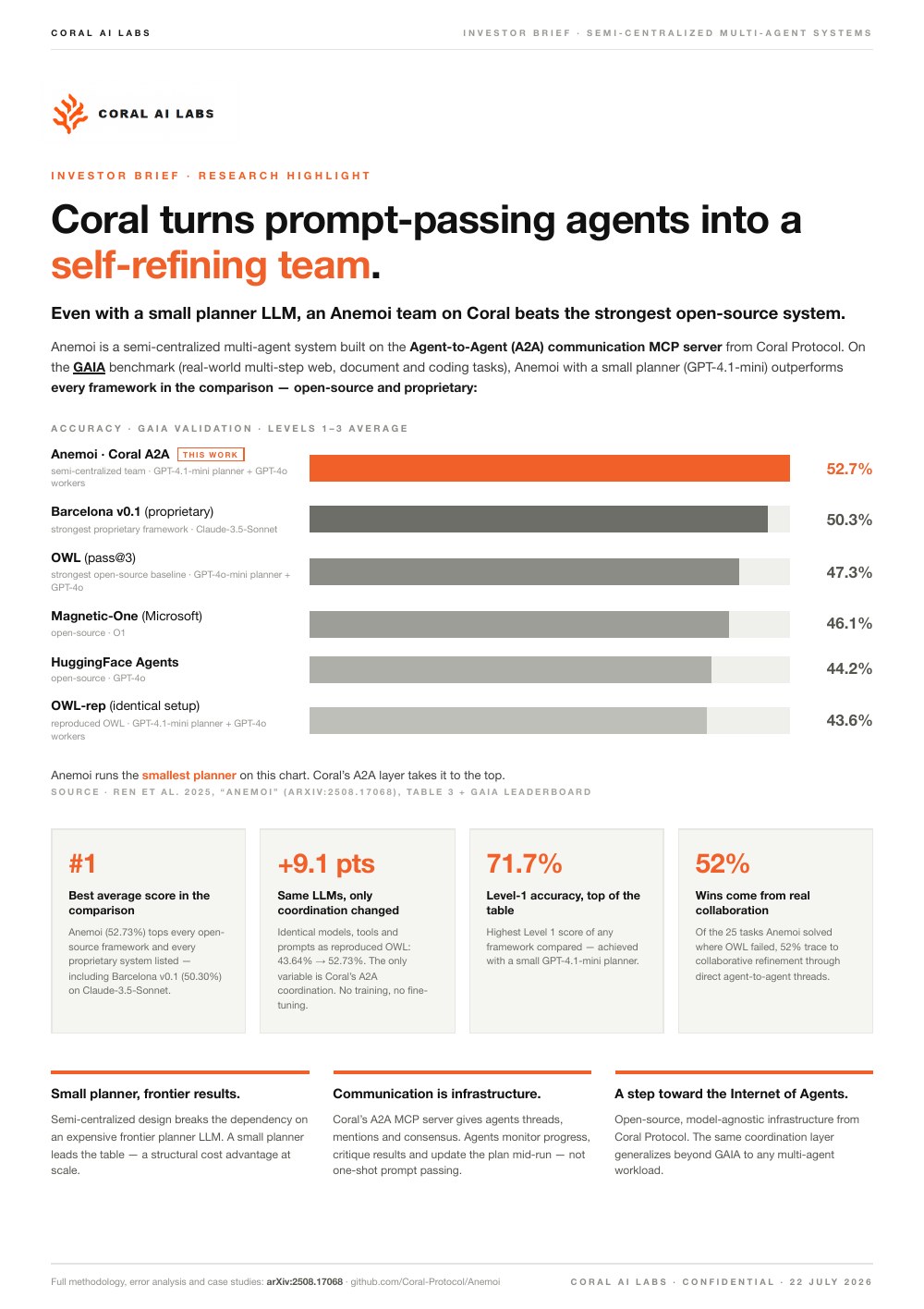
Small-model agent teams outperformed frontier-model systems on GAIA.
Applied AI lab for coordinated intelligence
Coordination is a
scaling axis for intelligence.
We are an applied AI lab building coordination infrastructure for multi-agent intelligence. CoralOS is our platform. Coral Code brings that coordination into the IDE for software engineering.
A two-axis field shows model capability horizontally and coordination vertically. At the same model capability, Coral moves isolated execution upward into a coordinated system, increasing the capability of the system without replacing its underlying model or agent.
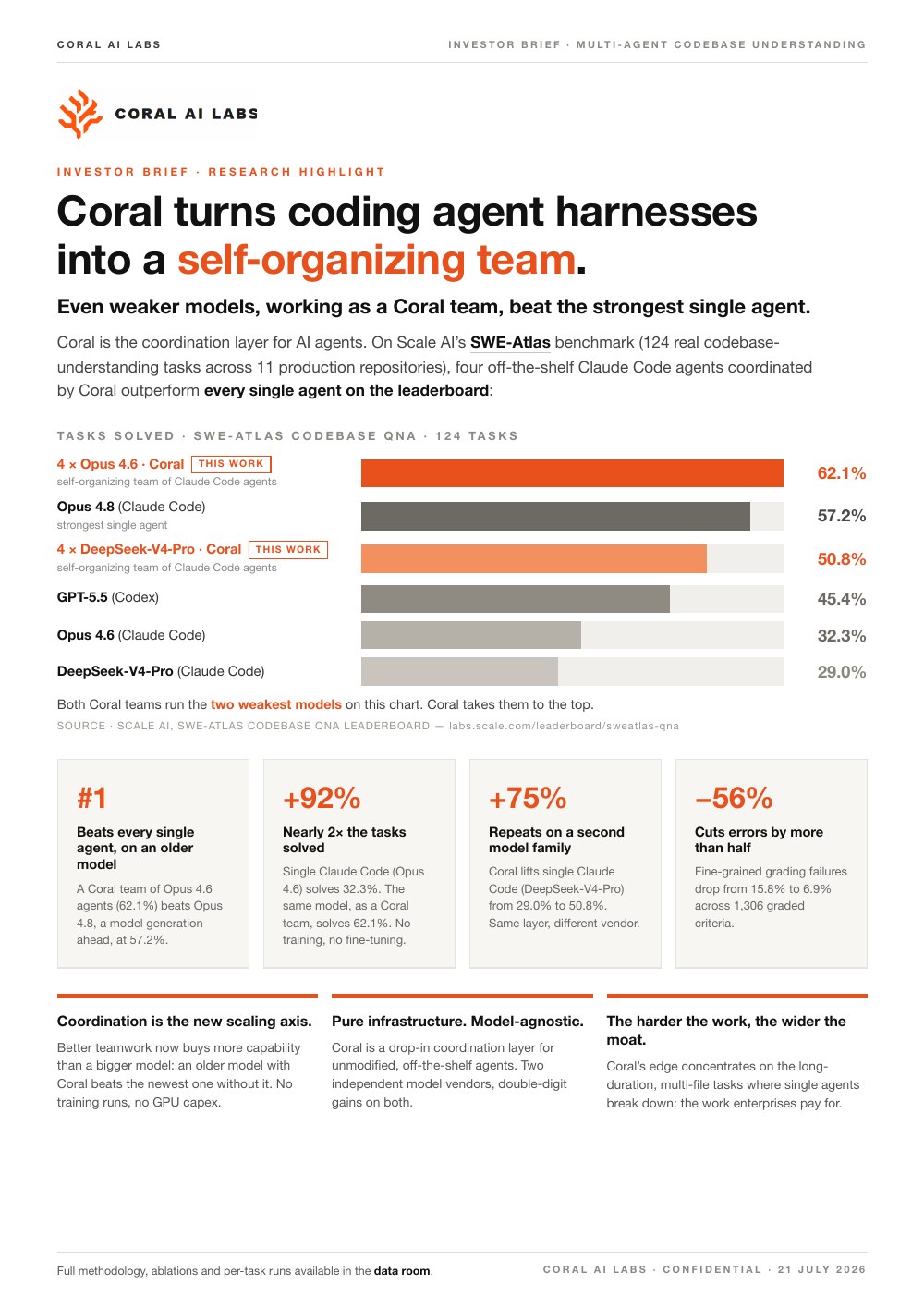
Coral moved DeepSeek from #11 to #1 on Scale AI SWE Atlas, at over 80% lower cost.
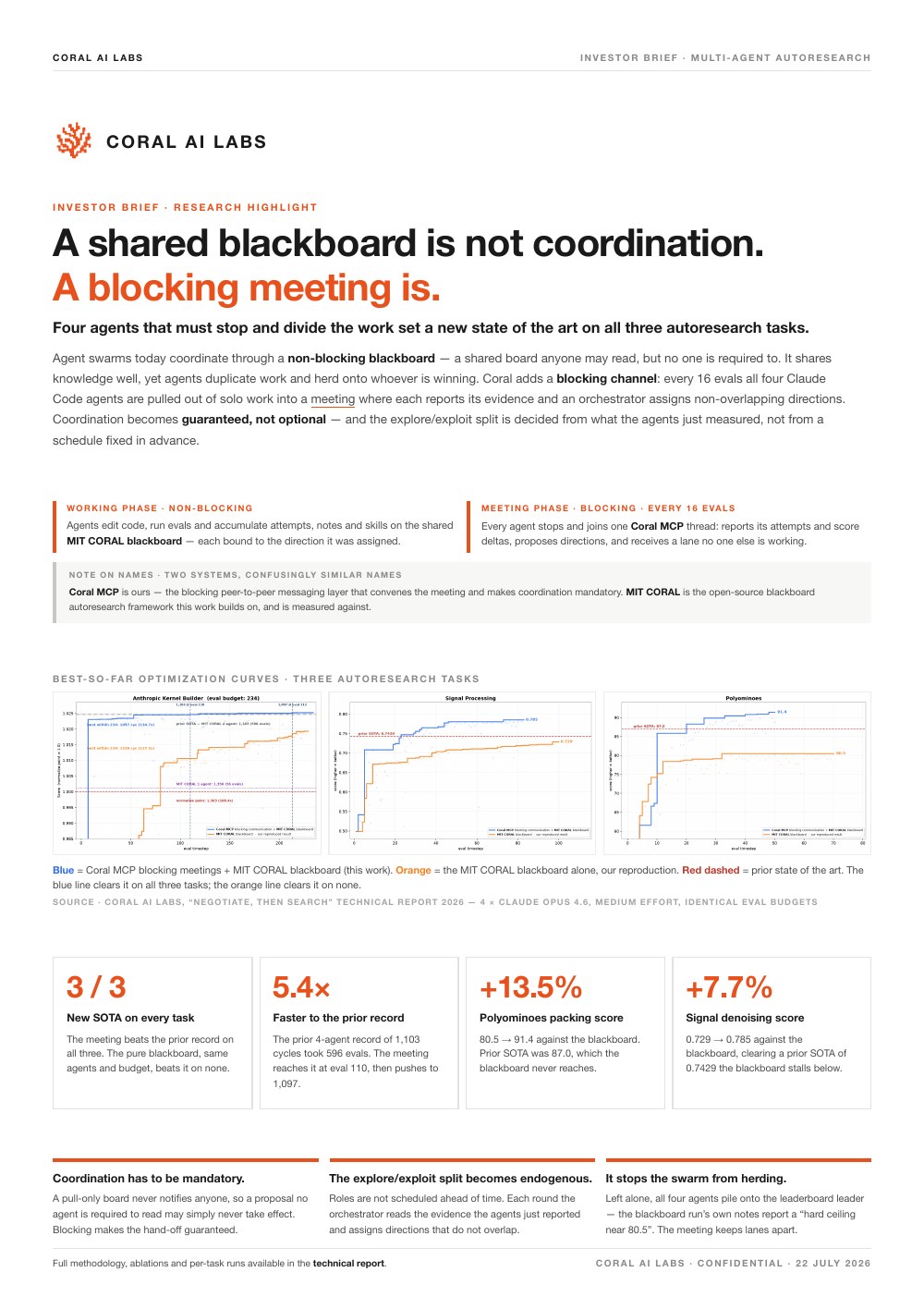
Coral agents beat the prior state of the art in 3/3 experiments, using 5.4× fewer cycles on one task.
APPLIED RESEARCH TO PRODUCTION
One thesis, built into a platform and a product.
GAIA established our first proof. Controlled studies isolated the mechanisms. CoralOS carries them into Coral Code and the wider agent ecosystem.
Horizontal scaling through cooperating specialist agents.
Division of labour, negotiated direction and live awareness.
Server, Cloud, model proxy, Console and operating evidence.
An IDE-native system for coordinated software engineering.
MEASURED RESULTS
Coordination changes the capability of the whole system.
Coordination moved the performance frontier in two different domains.
Coral Code applies coordination in an IDE-native developer product engineers can install today. Our autoresearch result shows the same mechanism improving open-ended scientific search.
SOFTWARE ENGINEERINGDIFFICULT Q&A TASK · 26 RUBRICS
Coral + DeepSeek earned full credit where both baselines missed.
ConfigurationRubrics passedCost
DeepSeek V4 Pro + Coral CodeMini-SWE-Agent
$1.40Claude Fable MaxClaude Code baseline
$9.93DeepSeek V4 ProMini-SWE-Agent · without Coral
$0.10Coral closed all seven missing rubrics.
It also passed three more rubrics than Fable Max while costing $1.40 rather than $9.93.
Coral-authored experiment on one SWE Atlas Codebase Q&A task with a 26-point rubric. This workload-level result does not rank foundation models universally.
AUTORESEARCHCONTROLLED REPRODUCTION
Mandatory coordination raised the ceiling of open-ended search.
3/3
previous task records exceeded under matched evaluation budgets
Kernel record5.4× fasterto the previous 1,103-cycle result
Polyominoes80.5 → 91.4shared blackboard to Coral meetings
Signal denoising0.729 → 0.785shared blackboard to Coral meetings
A shared memory was not enough.
Requiring agents to stop, exchange evidence and take non-overlapping directions changed the outcome.
Coral-authored controlled reproduction: four Claude Opus 4.6 agents, medium effort and identical evaluation budgets. Baseline was the separate MIT-led, multi-institutional CORAL shared blackboard.
RESEARCH & EVIDENCE
Read the work behind the system.
Our research follows the same thesis from protocol to product: coordinated agents can solve work that isolated agents miss.
View the full research library01 / 07
01
Coral Coordination
Our controlled 124-task SWE Atlas study shows Coral coordination raising Opus 4.6 task resolution from 32.3% to 62.1%.
02
Autoresearch
Mandatory coordination beat the reproduced blackboard baseline and exceeded the cited prior best across all three tested tasks.
03
ANEMOI
With the same workers, tools and prompts, Coral coordination raised GAIA pass@3 from 43.64% to 52.73% using a small planner.
04
Beyond Rule-Based Workflows
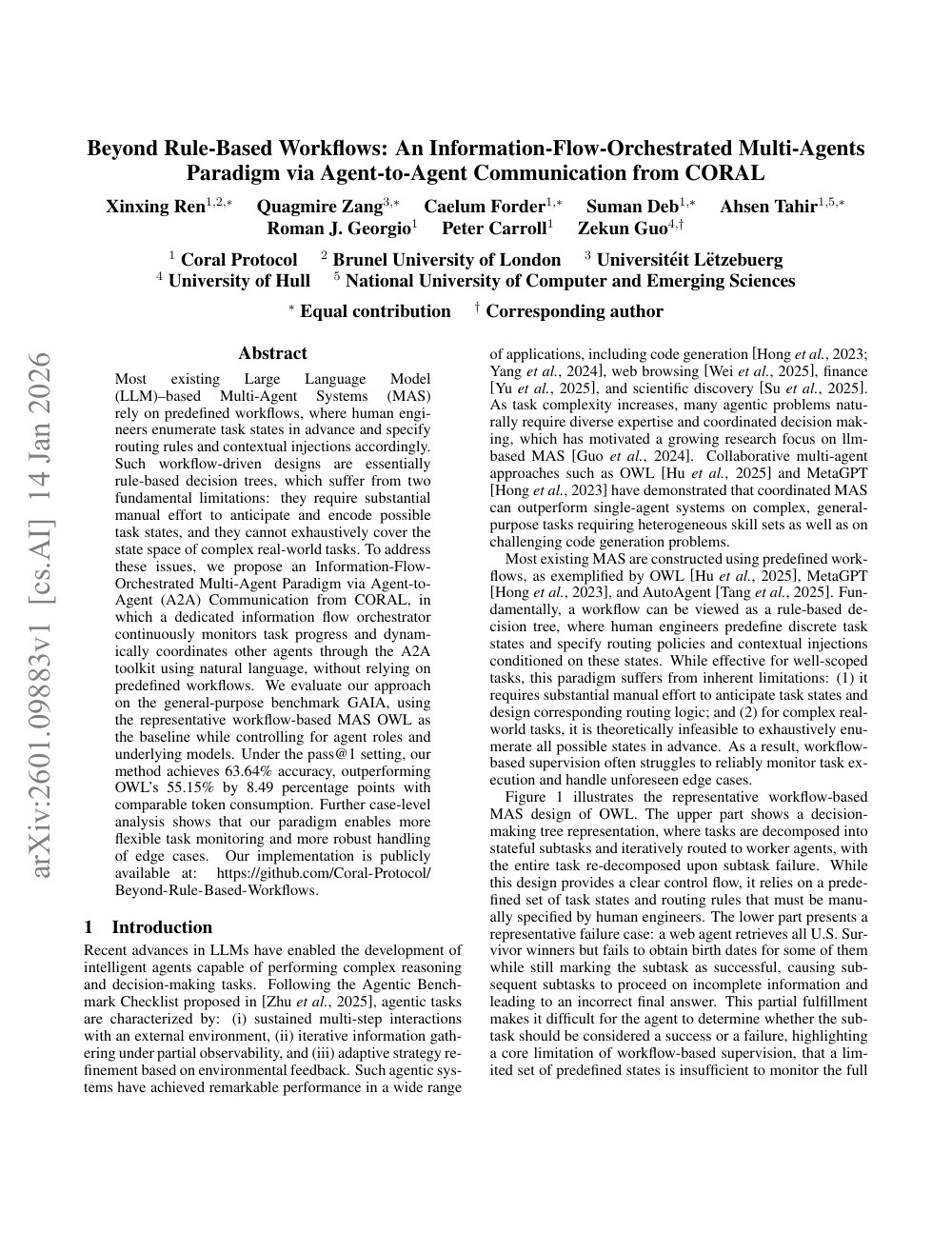
With the same roles and models, dynamic information-flow coordination reached 63.64% GAIA pass@1 versus 55.15% for OWL.
05
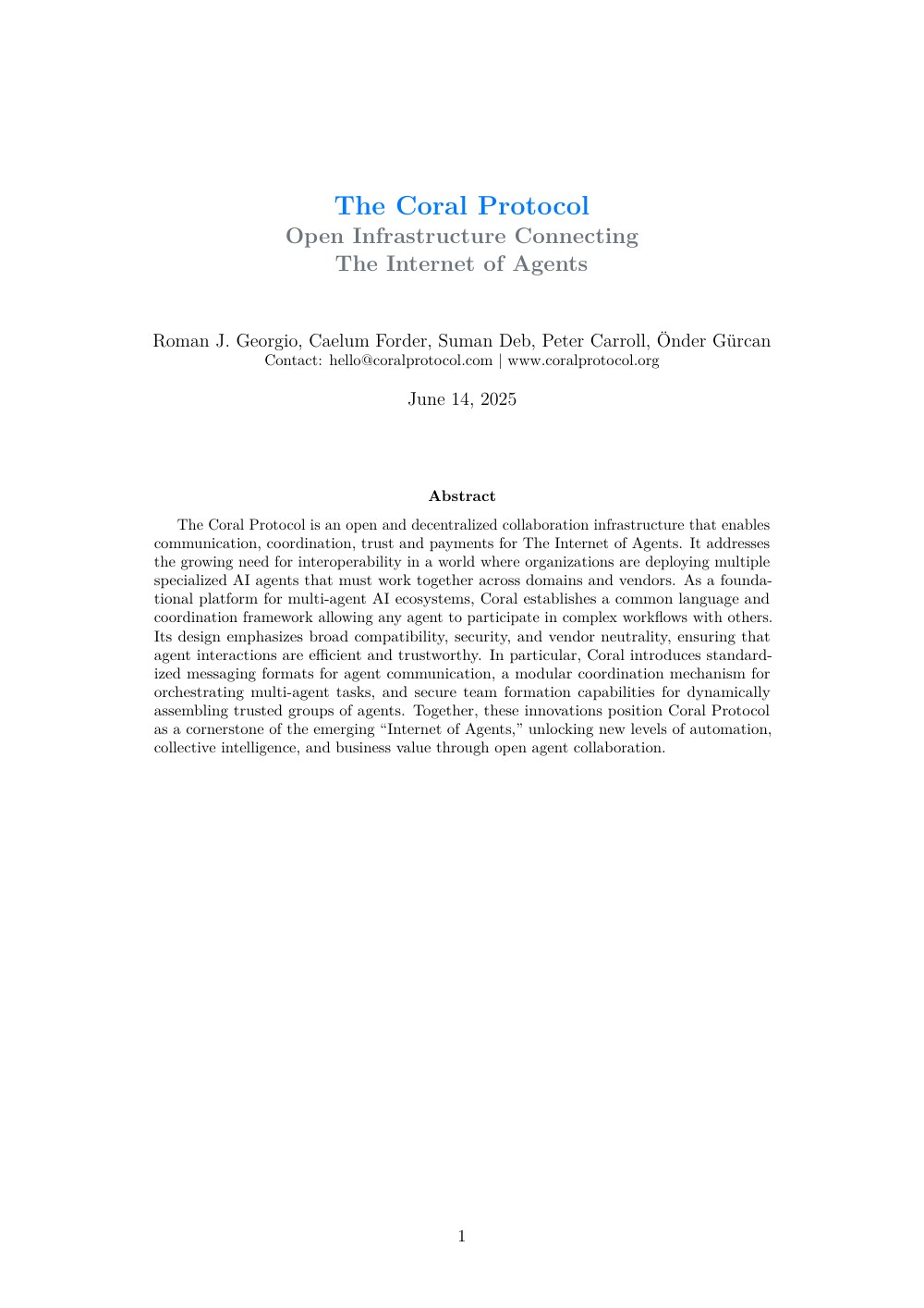
The Coral Protocol
Our 2025 paper defines open, vendor-neutral infrastructure for agent communication, coordination and secure team formation.
06
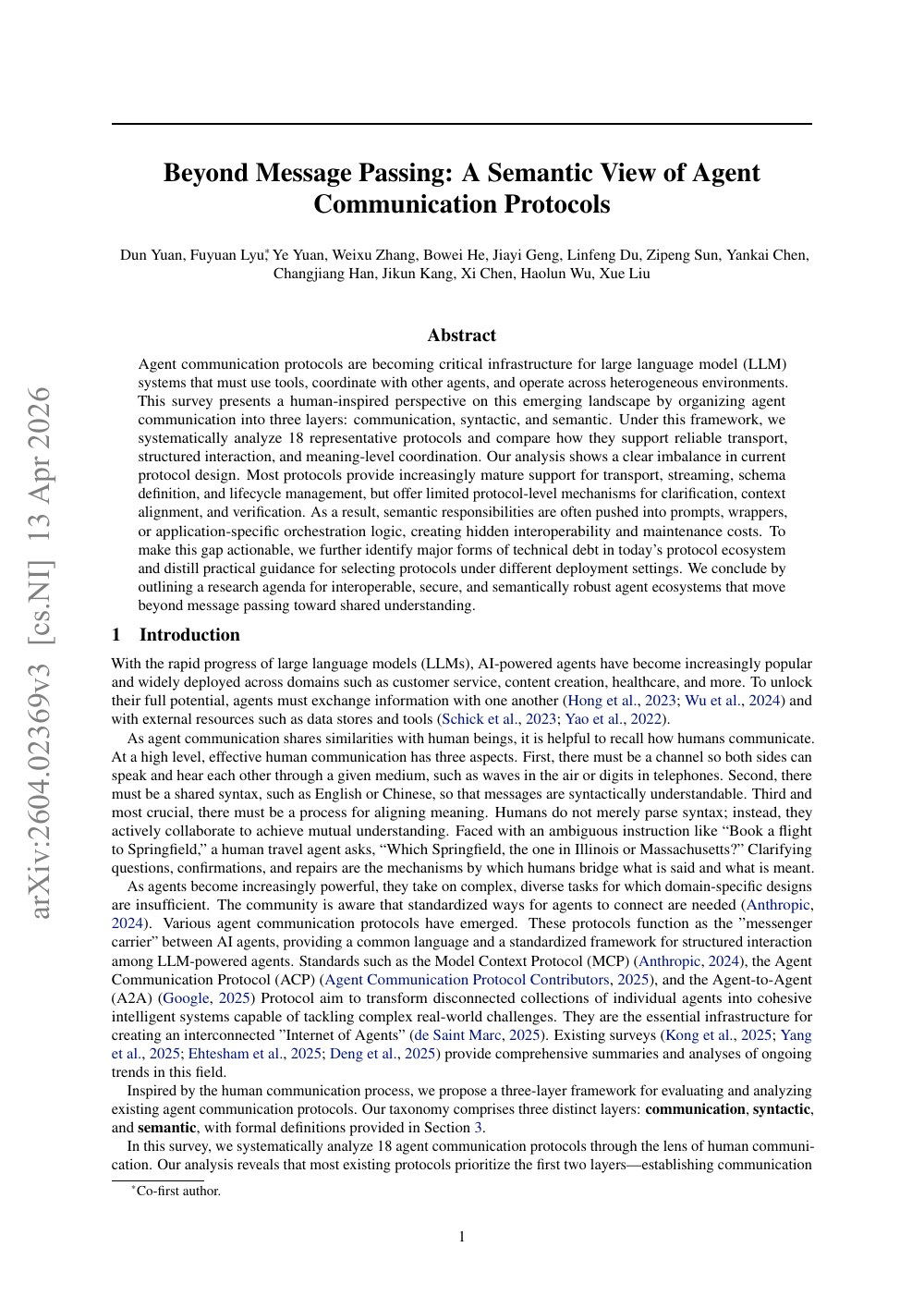
Beyond Message Passing
Researchers compare 18 protocols across transport, syntax and semantic alignment, including Coral’s context and verification model.
07
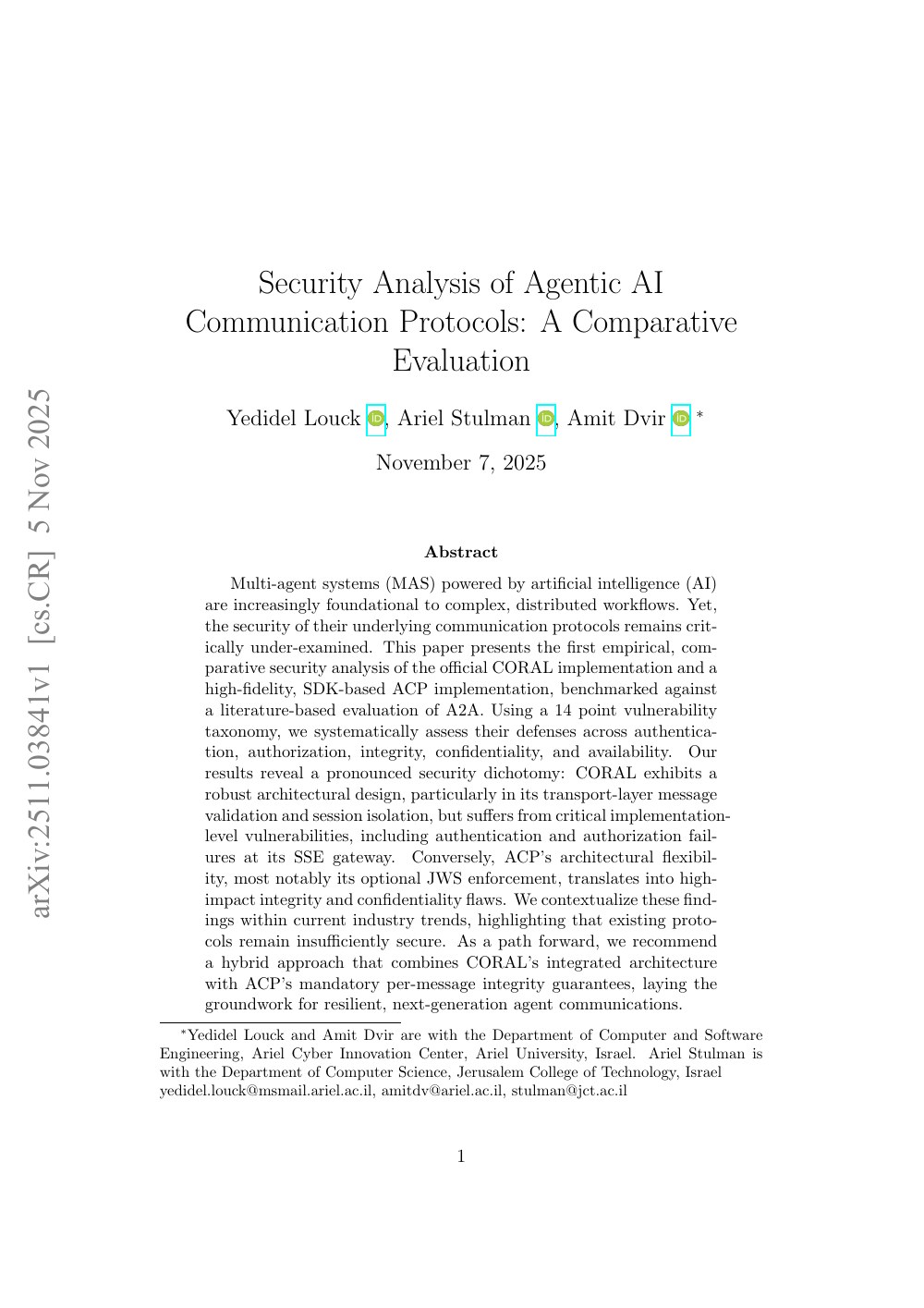
Security of Agent Communication Protocols
An independent comparison ranked the tested 2025 Coral implementation ahead overall and led to coordinated disclosure and remediation.
INDEPENDENT RESEARCH
“Coral protocol advances the state of multi-agent interoperability… toward verifiable meaning, trust, and incentive alignment.”
CORAL CODE
Coordination-native software engineering
Agent Chat, repository intelligence and coordinated work in one IDE.
Coral Code keeps a live structural map of the repository beside the coding agent. For hard tasks, Agent graph creates scoped specialists to investigate, edit and verify. Their operations, changes, evidence and uncertainty remain visible, with model and usage signals when the selected agent exposes them.
Ground the agent in the repository
Project structure, symbols, file relationships and recorded execution paths give each specialist bounded context for the task.
Turn hard work into an Agent graph
Scoped agents investigate, edit and verify across connected files. Everyday and High certainty modes set the depth of evidence.
Inspect the work behind the answer
Follow operations, agent activity and attributed changes beside the code. Coral preserves evidence, marks uncertainty and shows reported resource use.
BUILT-IN AGENT CHATCodexJetBrains JunieClaude
External coding agents can join live Coral sessions through MCP.
TECHNOLOGY
CoralOS
The coordination operating system for multi-agent AI.
Teams keep the models, agents, harnesses and tools they already use. CoralOS coordinates them through a shared runtime, communication layer and operating surfaces.
- Model and agent neutral
- Top-down or bottom-up graphs
- Local, self-hosted and Cloud-supported execution
COORDINATION OPERATING SYSTEM
CoralOS
Orchestrate · communicate · discover · run · inspect
01Orchestrate
Coral ServerRuns agent graphs, launches agents and manages coordinated sessions.
02Communicate
Coral ProtocolGives agents shared threads and direct messages for agent-to-agent communication.
03Discover
Marketplace & RegistryLists and discovers reusable agents. CoralOS resolves selected agents into executable graphs.
04Run
Coral Cloud InfrastructureRuns managed CoralOS through an API, with model proxying and usage metering.
05Inspect
Coral ConsoleCreates, monitors and debugs sessions, threads and agent behaviour.
ModelsAgentsToolsRepositories
PRODUCTS
Built on CoralOS
Coral Code for engineers. Coral Cloud for teams.
Coral Code is free to install. Model use runs through Coral Cloud or the selected agent's account. Teams use Coral Cloud for managed coordination and model consumption. Enterprise deployments add governance, security controls and support.
Coral Code
For engineers and technical leadsRun Codex, Junie or Claude in the same JetBrains workspace as the repository graph, coordinated operations and evidence.
Coral Cloud
For software teamsRun managed coordination and model usage across repositories with subscriptions and usage metering.
Coral Cloud Enterprise
For private and governed deploymentsPrivate deployment, governance, committed capacity, security controls and support.
START WITH CORAL CODE
Add coordination to the coding agent you already use.
Use Codex, JetBrains Junie or Claude. Switch on Agent graph when the task needs scoped specialists, deeper tracing or stronger evidence coverage.
APPLIED AI LAB
The team behind Coral
We research coordinated intelligence and build the systems that apply it.
The same team develops our research, CoralOS platform and Coral Code product.
Founder & CEO
Founder & CTO
Lead AI Researcher
AI Solutions Architect
MTS, Applied AI
PRESS & MEDIA
Coral in the conversation
Selected coverage of our work on coordinated intelligence.
Interviews, independent analysis and reporting on Coral's research, infrastructure and product progress.
Press enquiriesIndependent editorial · AgentRadio
VentureBeatFour AI Agents Coordinating in Real Time Outperformed Claude Opus 4.8 on Enterprise Coding Tasks
A detailed account of AgentRadio, passive awareness and the SWE-Atlas study showing what changes when agents can share discoveries while they work.
01
Coral Protocol: Architecting Security for the Internet of Agents
02Coral v1 Released With Model Context Protocol Runtime
03An Internet of AI Agents? Coral Protocol Introduces Coral v1
04Top AI Papers of the Week
05Coral Protocol Hits Top GAIA Benchmark With Its AI Mini-Model
06How Coral Protocol Is Building the Internet of Agents
Coverage links open on the original publisher. Research papers, methods and supporting code are collected above.
PUT CORAL TO WORK
Try Coral Code on your own repository.
Use your coding agent inside Coral Code. Keep repository structure, coordinated work and evidence in one system.